Corollaries Nobody Wrote Down

The machine didn’t know what it had just proved. In September 2026 OpenAI posted a collection of 719 mathematics manuscripts. Reading its mathematical-physics part, I kept running into the same pattern: a main theorem settles some statement X; the literature has known for decades that “if X then Y”, where Y is itself a named open problem; nobody writes down Y. It isn’t in the paper, and it isn’t in a footnote either. I searched all 719 manuscripts and the literature, and could not find any of the four corollaries below stated anywhere. None of them needs new mathematics. Each one is an OpenAI theorem plus a classical result, and all the depth is in the cited papers. My guess is that this is an agentic-harness effect. The corollaries the manuscripts do state reuse the proof’s own machinery (examples below). What gets missed is noticing that a theorem answers someone else’s question, posed in a different language. That takes a literature step nobody seems to have run. ...
October 8, 2026 · 9 min · 1873 words · PeaBrane
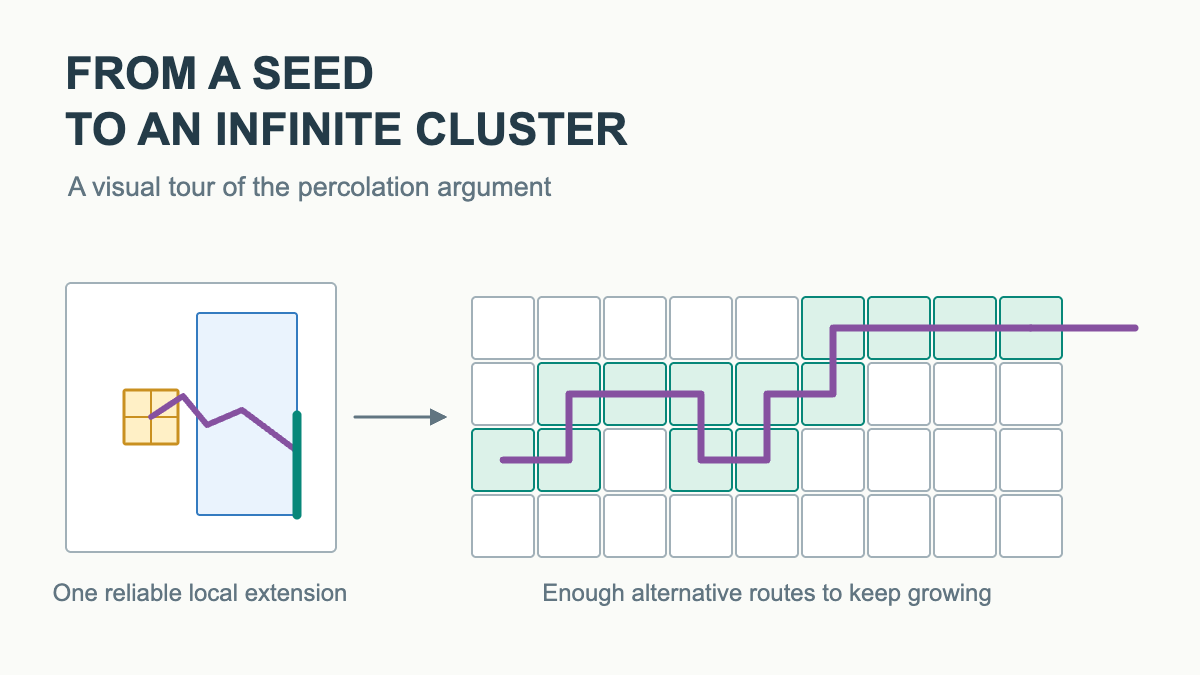
A visual proof route from a small seed through neighboring boxes to an infinite connected cluster

From a Seed to an Infinite Cluster

The part of this percolation argument that kept tripping me up was the collection of boxes. There is a seed box, a buffer around a different box, an auxiliary cube, a target inside a neighboring coarse box, and then a sequence of contractions and translations. What is actually moving? Why would making a target smaller help? And if fully open seeds are rare, aren’t we spending all our probability before we get anywhere? This is the version I wanted to read: the whole geometric and probabilistic route, in pictures, with the error budgets left out. We will take the gluing theorem as given. Its matrix and cone proof is a separate project; the question here is what that theorem lets us build. ...

October 8, 2026 · 15 min · 3089 words · PeaBrane
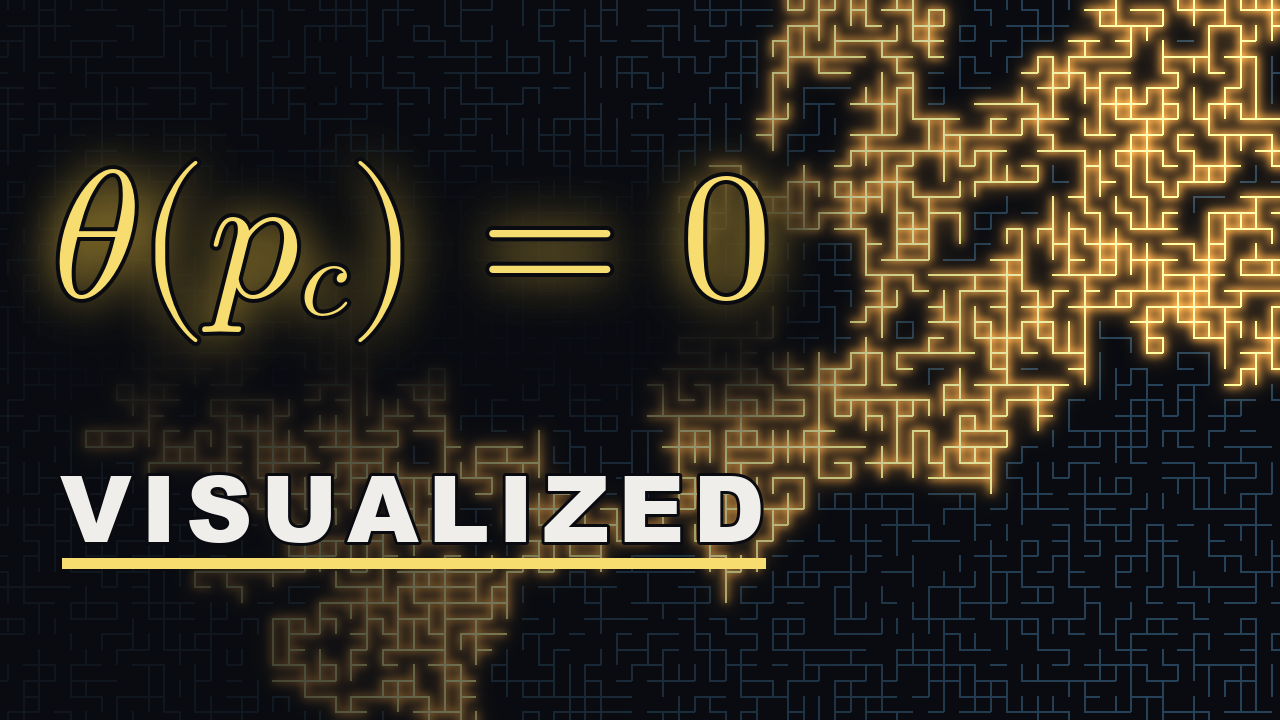
θ(p_c) = 0, visualized: a glowing critical percolation cluster

No Percolation at Criticality: the θ(p_c) = 0 Proof, Visualized

Open each edge of a lattice independently with probability p. Above a critical value pc an infinite open cluster appears. But is there one exactly at pc? This is the θ(pc) = 0 problem of percolation theory. It was settled in two dimensions by Harris and Kesten, and in high dimensions by the lace expansion, but stayed open for dimensions 3 to 10 for decades. A September 2026 preprint posted by OpenAI claims a proof for every ℤd and every quasi-transitive graph with pc < 1. I made a 13-minute animated tour of how the argument works. ...

October 7, 2026 · 10 min · 2042 words · PeaBrane