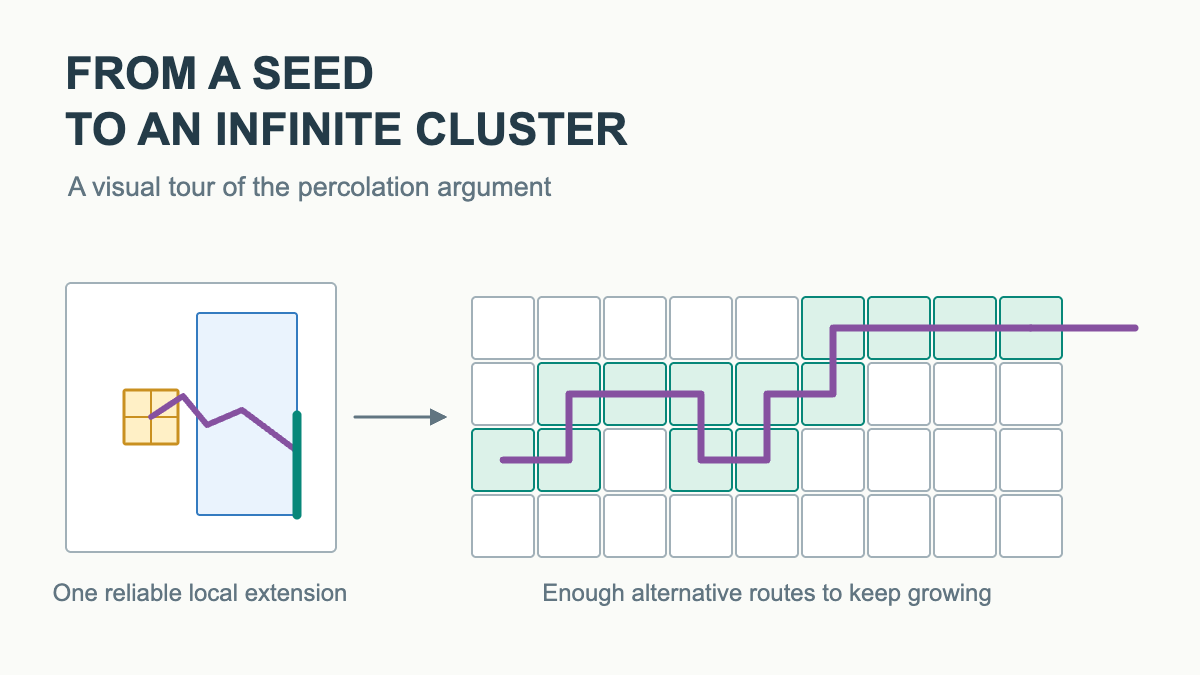
A visual proof route from a small seed through neighboring boxes to an infinite connected cluster

From a Seed to an Infinite Cluster

The part of this percolation argument that kept tripping me up was the collection of boxes. There is a seed box, a buffer around a different box, an auxiliary cube, a target inside a neighboring coarse box, and then a sequence of contractions and translations. What is actually moving? Why would making a target smaller help? And if fully open seeds are rare, aren’t we spending all our probability before we get anywhere? This is the version I wanted to read: the whole geometric and probabilistic route, in pictures, with the error budgets left out. We will take the gluing theorem as given. Its matrix and cone proof is a separate project; the question here is what that theorem lets us build. ...
October 8, 2026 · 15 min · 3089 words · PeaBrane
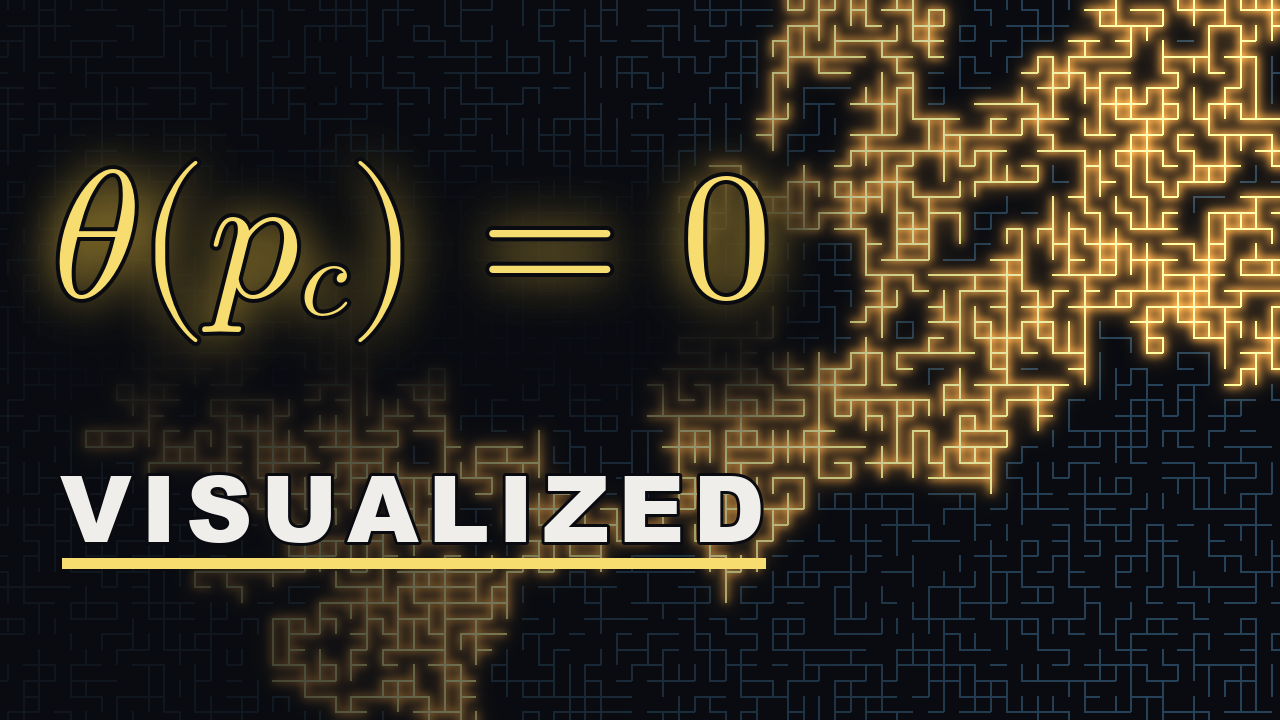
θ(p_c) = 0, visualized: a glowing critical percolation cluster

No Percolation at Criticality: the θ(p_c) = 0 Proof, Visualized

Open each edge of a lattice independently with probability p. Above a critical value pc an infinite open cluster appears. But is there one exactly at pc? This is the θ(pc) = 0 problem of percolation theory. It was settled in two dimensions by Harris and Kesten, and in high dimensions by the lace expansion, but stayed open for dimensions 3 to 10 for decades. A September 2026 preprint posted by OpenAI claims a proof for every ℤd and every quasi-transitive graph with pc < 1. I made a 13-minute animated tour of how the argument works. ...

October 7, 2026 · 10 min · 2042 words · PeaBrane