On 20 November 2026 Levent Alpöge released a Lean 4 development, made with Claude, that claims a formal proof of the Riemann hypothesis and of GRH for Dirichlet L-functions. It has about 175,000 files and 17 million lines, and no comments. I have written a reading guide to it: what the argument is, which parts are standard background, where the weight rests, and how human readers could split up the work of understanding and checking it.
Read it: Zenodo, doi:10.5281/zenodo.24405360 · PDF
Status. At the time of writing, no independent check of the development had been reported. I did not build it, and the note makes no claim that the proof is correct. It reads the development’s definitions and theorem statements and the author’s four-page remark. Every step is tied to a frozen file and line at a pinned commit of a byte-exact public mirror.
At a glance
- About 81% of the lines re-prove standard or published mathematics: étale cohomology, resolution of singularities, p-adic Hodge theory, arithmetic intersection theory, theta correspondences, automorphy lifting. This can be set aside, except for a few inputs inside it that the argument depends on: the covolume bound, the Galois-representation and local inputs, and parts of the archimedean budget.
- About 19% is candidate new argument.
- About 5% (≈0.85 million lines) is the core the note maps.
- The top-level
Formalism/Statement*.leanfiles are abandoned designs, never proved or used. Don’t start reading there.
The argument in one paragraph
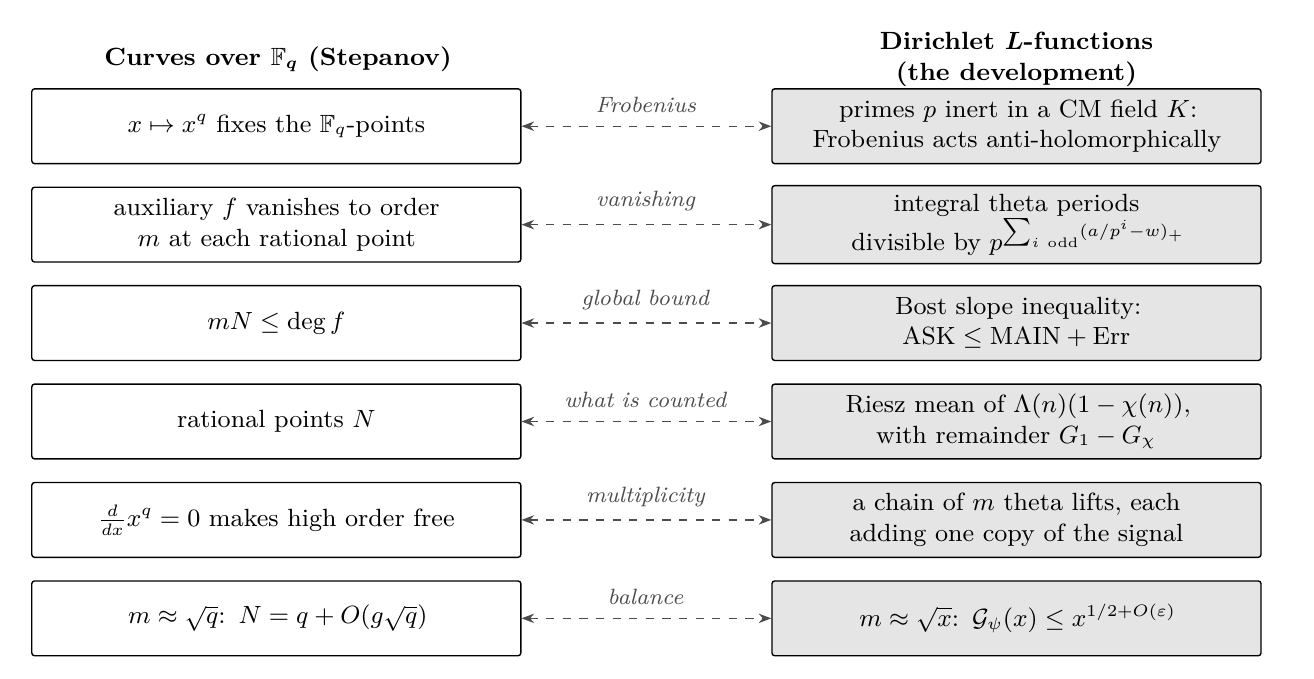
As I read it, the development runs Stepanov’s method over ℤ. Stepanov proved the Riemann hypothesis for curves over finite fields with three ingredients: Frobenius makes high-order vanishing free at the points being counted, a degree bound turns vanishing into a count, and a multiplicity parameter is traded against the global cost. The development replaces each of these:
- Frobenius. At primes inert in a CM field, integral theta-function periods are forced to be divisible by a large power of p. Summed over p, those exponents form a Riesz mean of Λ(n)(1−χ(n)).
- Degree bound. An averaged Bost slope inequality from Arakelov geometry. The archimedean side of the same objects (Stirling and the Chowla–Selberg period) is exactly the explicit-formula main term, so the inequality reads “prime sum ≤ its own main term + error”.
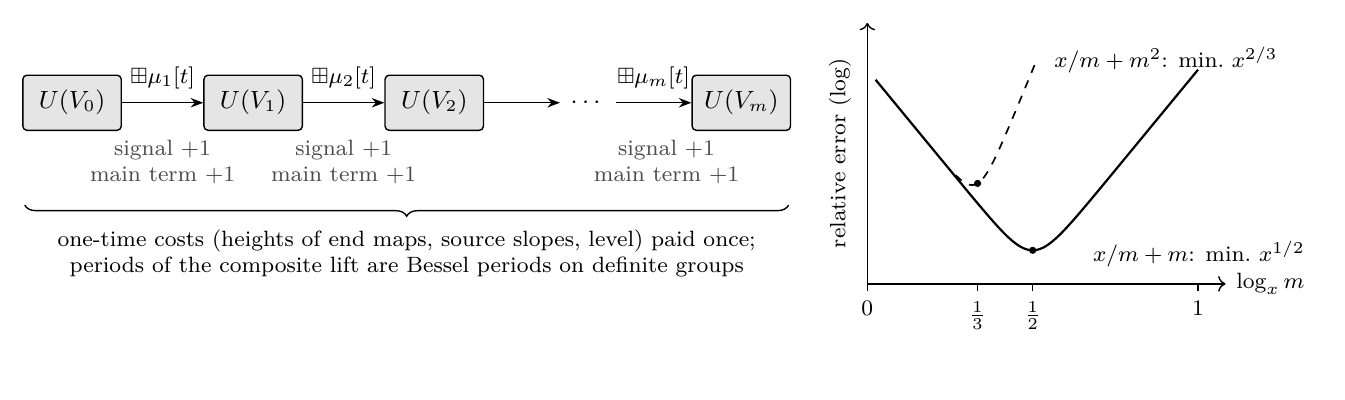
- Multiplicity. Over ℤ there is no derivative to raise it. The development instead lifts m ≈ √x times between definite unitary groups by theta correspondence. Each lift adds one copy of the signal, while the global costs are paid once. The error x/m + m is smallest at m ≈ √x, and that is where the exponent 1/2 comes from.
Finite Fourier analysis over an auxiliary abelian field and a windowed form of Landau’s theorem then turn the one-sided bound into zero-free half-planes.
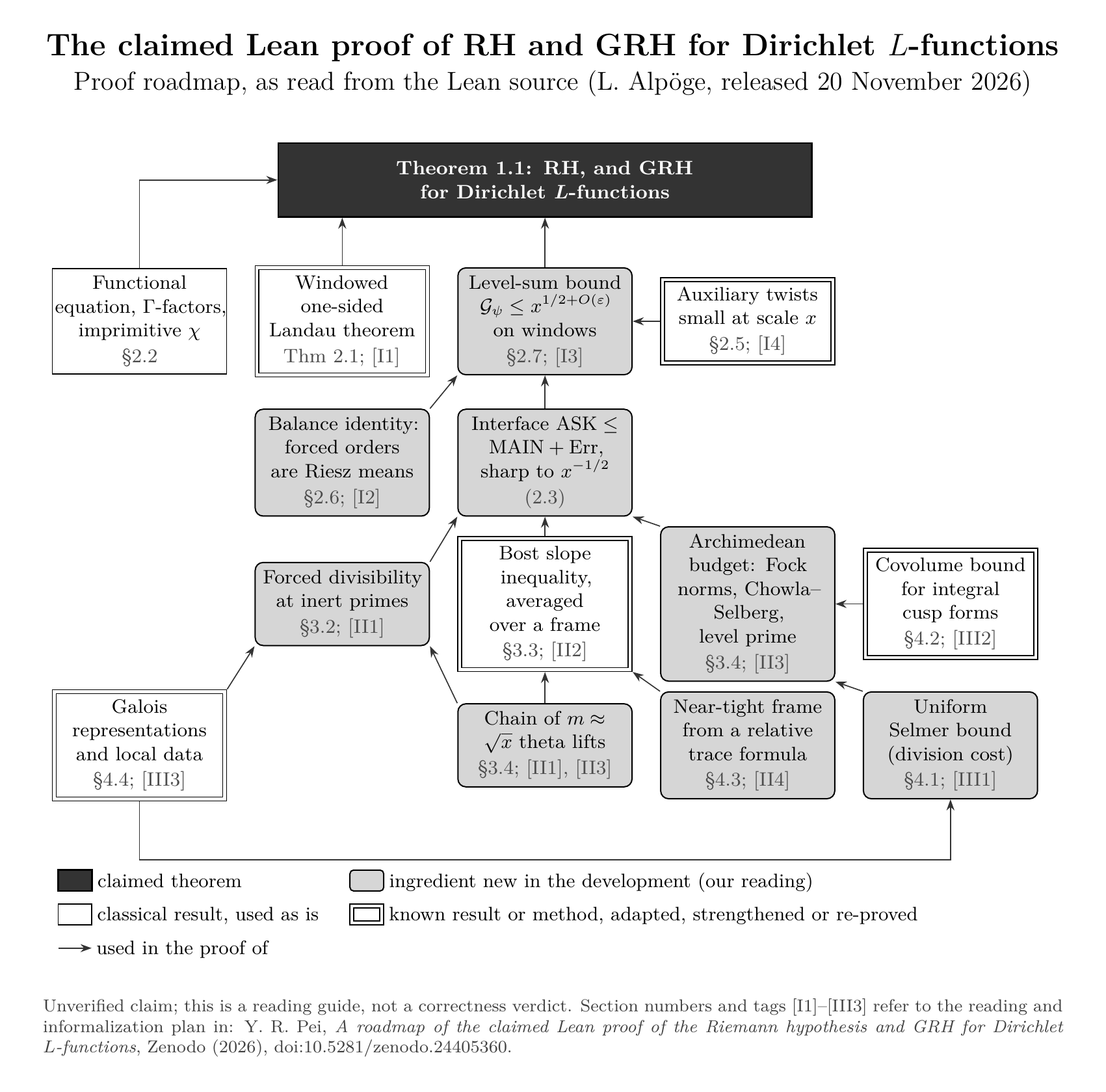
How the claimed theorem is proved, as I read it. Shaded boxes are steps without a classical model; double-bordered boxes are steps whose statement or method has one (Landau, Bost, second moments, arithmetic proportionality, Galois representations), even where the development’s version is new. Tags such as [II1] refer to the reading plan below.
Where to look first
These are not findings of error. They are where, in my reading, the weight of the argument rests.
- Forced divisibility. The claim is that Bessel periods of m-fold iterated theta lifts are divisible by the inert-prime “factorial excess”, on a sublattice of small colength. I know of no published analogue. Along one code path the relevant clause holds only by definition, so check the binding to a real valuation first.
- Sharpness. The slope inequality must be exact to relative error x−1/2, uniformly over unitary groups of rank polynomial in x and fields of degree about x².
- The Selmer bound. It needs a bound on Selmer groups of Dirichlet characters that is uniform in ℓ. That is a theorem of independent weight; the author describes it as a significant weakening of Vandiver’s conjecture.
- The covolume bound. It needs arithmetic proportionality on general-signature unitary Shimura varieties, which the literature has in special cases only.
- Two weakened inputs. The slots named for local Langlands and for Caraiani’s local–global compatibility are filled by weaker statements.
A plan for human readers
The note proposes eleven write-up targets in three tiers, each with its Lean entry points and what to check first:
- Tier I, self-contained analytic statements. These are short and need only analytic number theory, so they make good first targets:
- [I1] the windowed one-sided Landau theorem;
- [I2] the balance identity;
- [I3] the deduction to the level-sum bound;
- [I4] the choice of auxiliary conductors by second moments.
- Tier II, the arithmetic heart. These decide whether the method works:
- [II1] forced divisibility, with a CM-curve warm-up;
- [II2] the slope inequality with frame defects;
- [II3] the archimedean budget;
- [II4] near-orthogonality from a relative trace formula.
- Tier III, inputs of independent weight. Each could be a paper; start with a statement-level audit:
- [III1] the Selmer bound;
- [III2] the covolume bound;
- [III3] the Galois-representation and local inputs.
Suggested order: [I1], [I2] and the cheap audit [III3]; then the warm-up for [II1], because if that fails nothing downstream matters; then [I3] with [II3]; then the rest.
Inspection of the Lean code and the writing of the note were done with substantial help from the AI models Claude Opus 5.5 and Claude Fable 5.2.